We’ve all been there – you find the perfect Airbnb, only to watch the price balloon at checkout as service fees and cleaning charges pile up. That exciting $200-per-night dream rental suddenly becomes a budget-busting nightmare. But just how bad are these fees, and do they vary depending on where you’re staying? A new analysis of Airbnb listings across 84 major U.S. cities reveals some surprising answers about these controversial charges.
Key Findings:
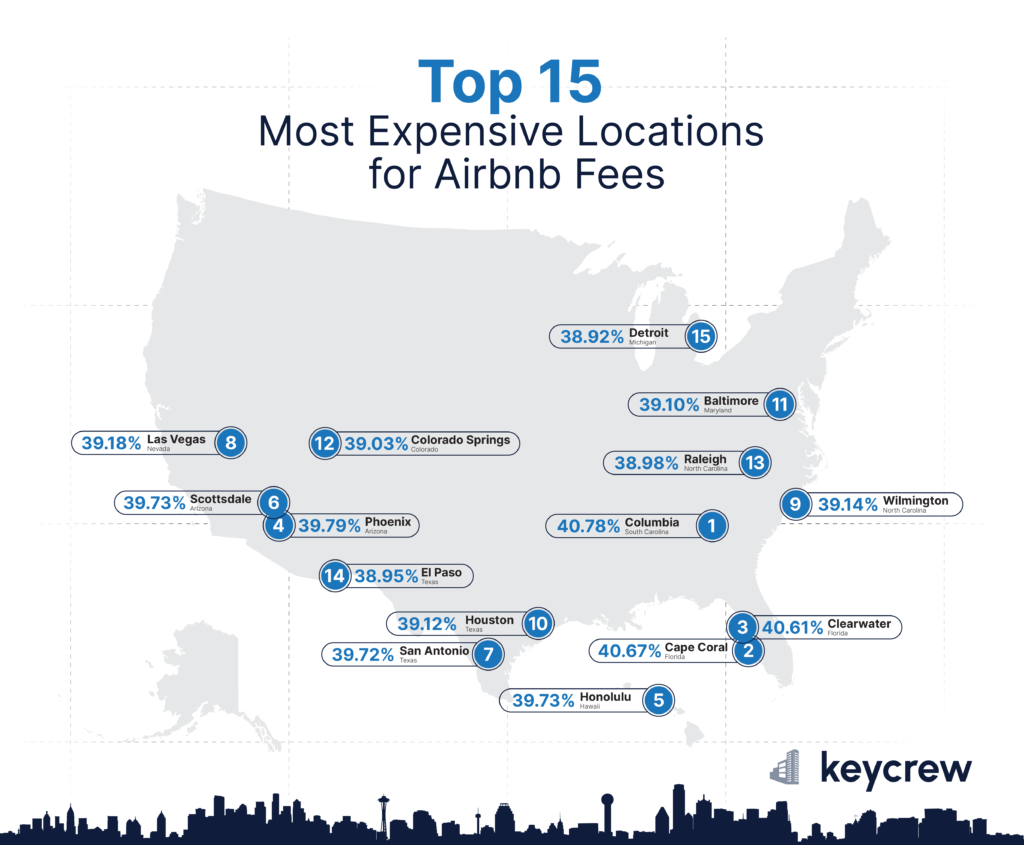
Some cities pile on average fees of up to 41% on top of the base room rate
Columbia, SC leads the nation with the highest relative fees (40.78%), adding $207 in fees to a $505 five-night stay
While California cities show the lowest fee percentages, they often have the highest dollar amounts in fees
The average combined service and cleaning fees across all cities is approximately $250 for a five-night stay
Florida dominates the high-fee percentage list with multiple cities in the top 10
Southern Cities Lead with Highest Percentage Fees Relative to Price
Columbia, South Carolina tops the list with combined service and cleaning fees reaching 40.78% of the total room price for a five-night stay. In real dollars, this means paying $207 in fees on top of a $505 base price. Florida cities feature prominently among locations with the highest fee percentages, with Cape Coral and Clearwater following closely at 40.67% and 40.61% respectively. In Cape Coral, this translates to a whopping $476 in fees on a $1,170 five-night stay.
The California Paradox: Lower Percentages, Higher Dollar Amounts
While California cities consistently show the lowest fee percentages, the actual dollar amounts tell a different story. Take Napa, for example: while its 23.19% fee rate seems modest, guests actually pay $473 in fees ($338 service fee + $135 cleaning fee) on a five-night stay. Santa Barbara charges $431 in total fees, and Newport Beach adds $515 in fees, despite their lower percentage ratings. This apparent paradox is explained by California’s significantly higher base room rates – Napa averages $408 per night compared to Columbia’s $101.
Major Metropolitan Areas: Middle Ground in Both Percentages and Dollars
Major metropolitan areas maintain moderate fee structures in both percentage and dollar terms. New York City charges about $237 in total fees on a $728 five-night stay (32.54%), Boston adds $225 in fees to a $695 stay (32.40%), and Philadelphia keeps fees to $154 on a $478 stay (32.27%). These figures suggest bigger cities have found a middle ground in their fee structures.
Airbnb Fee Examples
Let’s look at some concrete examples for a five-night stay:
Columbia, SC: $101/night → $505 base + $207 fees = $712 total
Cape Coral, FL: $234/night → $1,170 base + $476 fees = $1,646 total
Napa, CA: $408/night → $2,040 base + $473 fees = $2,513 total
New York City: $146/night → $728 base + $237 fees = $965 total
Consumer Implications
These findings highlight why it’s crucial to look beyond both percentage rates and base prices. While California’s fee percentages might look attractive at first glance, the actual dollar amounts can be significantly higher than in other regions. Conversely, while Columbia, SC’s 40.78% fee rate sounds steep, the actual fee amount ($207) is lower than many California cities charging half that percentage rate.
The data suggests that savvy travelers should consider both the percentage and dollar amount of fees when comparing locations. A high fee percentage in a budget-friendly city might actually cost less than a low fee percentage in an expensive destination. This nuanced approach to evaluating costs could lead to significant savings when planning your next Airbnb stay.
Methodology
In October 2024, we analyzed the 150 most searched for cities for Airbnbs according to Google search data, by searching for a five-night stay for 1 person for an entire home from December 16 to 21, 2024 in each of these locations on Airbnb. We then removed any city from our list with an insufficient amount of available rentals, to leave only the cities with a sufficient quantity of rentals to provide a fair average for each location. We collected the room price, cleaning fee and service fee for each rental, then calculated the average for each city.
This article was sourced from a live expert interview.
Every month we conduct hundreds of interviews with active market practitioners - thousands to date.
Every time a home goes on the market in the United States, the listing data – price, photos, square footage, descriptions – enters a multiple listing service. From there, that data gets copied. According to Tim Dain, President & CEO of NorthstarMLS, the regional MLS serving Minnesota, some MLS databases get replicated hundreds or even ...
The skilled-trade shortage in U.S. construction has persisted for years, but the industry’s response is taking a specific new form: developers are moving production into factories, and those factories are increasingly being built on American soil. For buyers in markets where labor constraints have slowed new housing and driven up prices, domestic factory production could ...
The company has already published over 5,000 articles in collaboration with over 1,800 market experts across all 50 states, powered by a tech-forward approach to research and reporting. MIAMI, FL – July 28, 2026: KeyCrew Media, the expert-sourced real estate news network, today unveiled KeyCrew Local, a network of local real estate news sites and ...
A 57-year publishing legacy joins forces with a modern editorial studio to deepen coverage and reach a new generation. SANTA FE, N.M. – July 23, 2026: Leading Estates of the World, the original luxury estates and lifestyle publication, today announced a partnership with KeyCrew Media to strengthen and elevate its coverage of the world’s finest ...
If you have ever watched an empty lot sit untouched for months, permit sign flapping in the wind, no workers in sight, and wondered what is taking so long, the answer may have less to do with lumber prices or labor shortages than you think. A growing number of development professionals argue that a quieter ...
Interest rates get most of the blame when commercial real estate deals stall. But in Houston’s industrial market in 2026, a different problem is collapsing deals that survive months of due diligence: federal policy that changes direction without warning. According to Shahin Naghavi, Managing Partner and Principal Broker at Riverside Equity Group, a boutique firm ...