Waterfront ownership carries a seasonal deadline that inland ownership does not. Somewhere between the last warm weekend and the first hard freeze, the dock has to come out, the boat has to be winterized, and the equipment that made the summer work has to be inventoried and stored. The deadline is set by weather rather than by calendar, which is what makes it easy to misjudge.
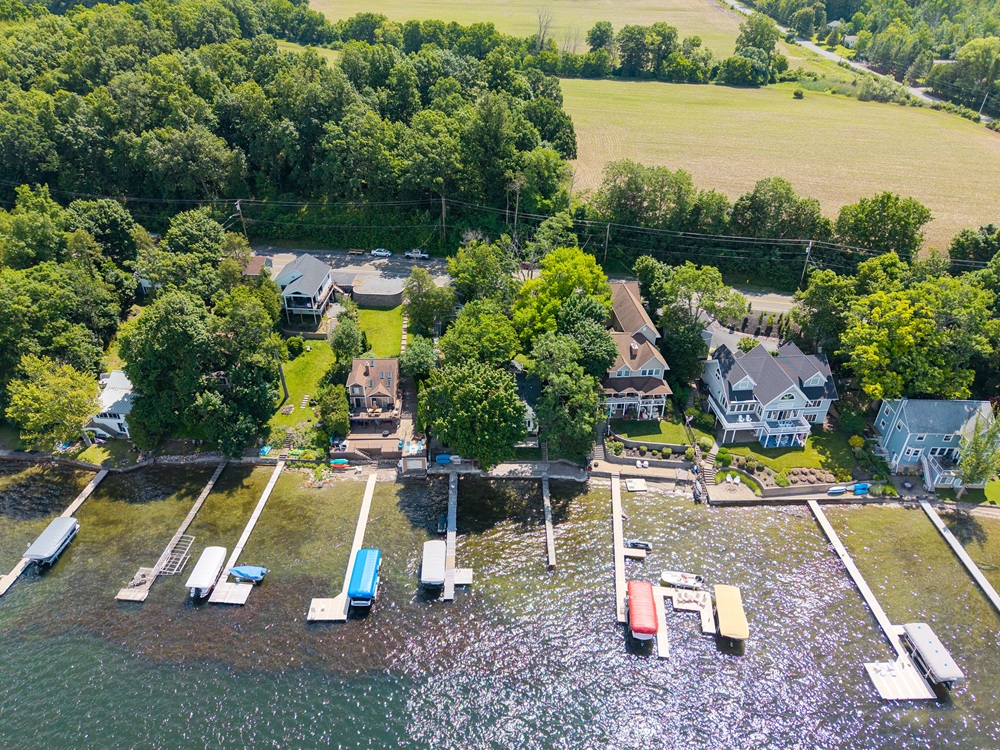
On Conesus Lake, in Livingston County, the practical planning window runs through September and October. New York State Parks lists the docks at the Conesus Lake Boat Launch as available from late April through October 15 – a public reference point rather than a rule for private owners, but a useful marker for how the season is generally timed on this lake.
A window, not a date
Matthew Sharman, team leader of The Sharman Team at Real Broker NY LLC, who works the Conesus Lake waterfront market, says there is no single correct date, and that owners who wait for one tend to wait too long.
“Winter comes unannounced often, and it stays,” he says.
The temptation runs the other way. An unseasonably warm weekend in late September produces a run of owners who regret having pulled early, which encourages the following year’s owners to hold on. Sharman’s advice is to work backwards from use rather than forwards from the forecast: decide realistically when the boat is finished for the year, coordinate the equipment, and book the removal appointment against that date rather than against the weather.
By October, he says, the margin narrows considerably. The risk is not only a cold snap but a scheduling one – the companies that pull docks compress most of their work into a few weeks, and an owner who calls late is bidding against every other owner who did the same.
“You’re not trying to win a contest for the last dock in the lake,” Sharman says.
The removal itself
Most owners hire out the work. Dock systems vary enough that there is no universal removal sequence, and the manufacturer’s instructions govern.
For owners handling it themselves, Sharman’s recommendation is documentation before disassembly. Photograph the system in place. Label sections discreetly so they can be reassembled in the same configuration. Some owners record video. The sections of a dock come apart faster than they go back together, and the knowledge of how they fit is usually stored in one person’s memory rather than anywhere retrievable.
“Future me will remember where this goes – that’s not a system,” he says.
Removal is also the only point in the year when most owners see the underside of their own dock, which makes it the natural moment to inspect and clean. Hardware should be consolidated and kept together rather than distributed across a garage.
Storage is the step buyers most often fail to consider before purchase. Some properties have a flat area where sections can be stacked through the winter. Others have neither the frontage nor the grade, which means the dock travels off-site and the cost of storage becomes an annual line item. Sharman notes this is worth establishing during a purchase rather than discovering the following autumn.
Material choice shapes the workload. Permanent installations are uncommon on Conesus, Honeoye and Silver Lake, and are more typical of the deeper lakes further east, where traditional boathouses and substantial fixed docking systems are found. On the shallower western lakes, most systems come out. Aluminum has become the prevailing choice, carrying a higher purchase cost against lower annual maintenance than wood, which needs paint, staining and periodic board replacement. Sharman describes the tradeoff as buy once, cry once.
The rest of the waterfront
The dock is one item on a longer list. Engines and onboard systems need fuel treatment, fluids and battery attention, and water has to be cleared from anywhere freezing could cause damage. Lifts and canopies need their own inspection, cleaning and drying. Ladders, furniture, kayaks, paddleboards, hoses, pumps and seasonal water connections all require a decision.
Electrical and water winterization are the two areas where Sharman suggests hiring a contractor if there is any doubt, since the failure modes are expensive and not always visible until spring. He also recommends the owner’s manual, particularly for a first winter, and a written checklist with a named responsible party for each item – on the grounds that the worst position to occupy is searching for a contractor while a problem is actively in progress.
Repairs are better done in late autumn than deferred. An owner who addresses damage in October or November is ready in spring; one who waits joins the queue.
Condition and resale
Sharman frames dock maintenance as protecting value and reducing uncertainty rather than producing a dollar-for-dollar return, and says he would not tell a seller that a given maintenance spend adds a specific amount to a sale price.
The asymmetry runs the other way, though. A deteriorated dock attached to an otherwise well-kept house is visible from the first showing and disproportionately affects how the whole property reads.
“The dock is your gateway to what everyone’s paying for, which is the lake,” he says.
This is one of the inputs Sharman weighs in a Property Value Review (PVR™), his valuation process for waterfront property, which accounts for condition, competing inventory, buyer behavior and property-specific features alongside the comparable set. A buyer who sees a maintained waterfront setup tends to extend that assumption to the house. A buyer who sees a neglected one starts calculating repairs instead of picturing summers.
For anyone buying into a waterfront property this autumn, Sharman’s practical point is that the handoff should happen before it is needed: who installs and removes the dock, where everything is stored, which service has been used, whether spring installation is a separate appointment, and which equipment actually conveys. Docks usually transfer with the property; hoists frequently do not. An assumption that is not written into the contract is an assumption that costs money.
About the Expert: Matthew Sharman is a lakefront and lifestyle real estate authority with The Sharman Team at Real Broker NY LLC, and top agent serving Greater Rochester, the GLOW region, and the western Finger Lakes, with particular expertise in Conesus Lake, Honeoye Lake, & Silver Lake.
This article is based on information provided by the expert source cited above. It is intended for general informational purposes only and does not constitute legal, financial, or real estate advice. Readers should conduct their own research and consult qualified professionals before making any real estate or financial decisions.