“The biggest things we’re seeing in the market right now are a drive towards stability,” notes Izzy Cannell, Workplace Insights Lead at VergeSense. “Companies are moving toward more rapid decision making than we’ve seen in recent years, with growing confidence in their space planning decisions.”
Five years after the pandemic dramatically altered workplace attendance, understanding precisely how office space is being used has become critical for real estate professionals and investors. VergeSense’s recently released Occupancy Intelligence Index brings clarity to these trends through detailed utilization data collected across global markets.
A New Level of Precision in Workplace Analytics
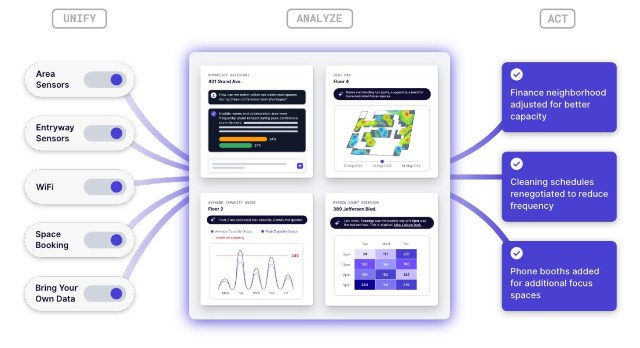
What sets VergeSense’s approach apart is its multi-layered data collection methodology. “We have coverage through our sensors, both from an entry-exit standpoint, as well as space measurement,” Cannell explains. “We measure what is going on within specific spaces, but we also measure overall in and out.”
This system combines physical sensors with Wi-Fi data to create a comprehensive picture of space utilization. With information from over 200 companies spanning the Americas, EMEA, and APAC regions, the index provides a global perspective on emerging workplace patterns.
The Evolution of Office Attendance
Despite early predictions about the permanent death of office work, the data tells a more nuanced story. “What a mandate is, is just an attendance policy,” Cannell states. “It’s how we work. It’s the way we’re working. And we’ve always had them.”
These attendance policies are creating distinct patterns:
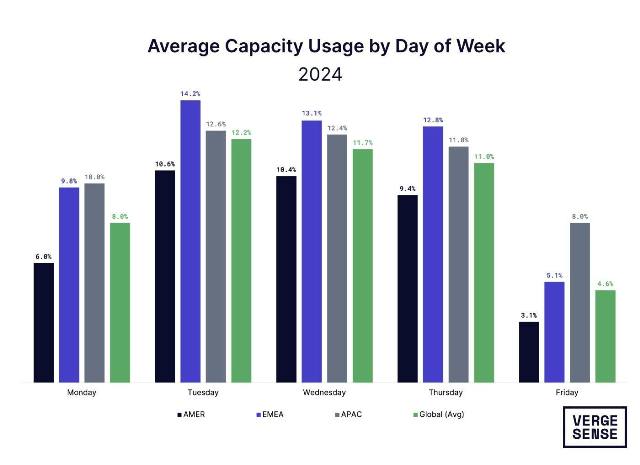
Monday utilization is increasing while Friday remains consistently low
Tuesday through Thursday continue as the strongest attendance days
Different sectors show varying adaptation rates, with financial services and government making notable shifts
“We’ve had some more vocal businesses coming out about their returns in four or five days,” Cannell notes. “The financial industry certainly is one of them, and we are seeing change in the utilization for those spaces.”
The Space Type Mismatch
Perhaps the most valuable insight for real estate professionals is the identification of a fundamental mismatch between office design and actual usage patterns.
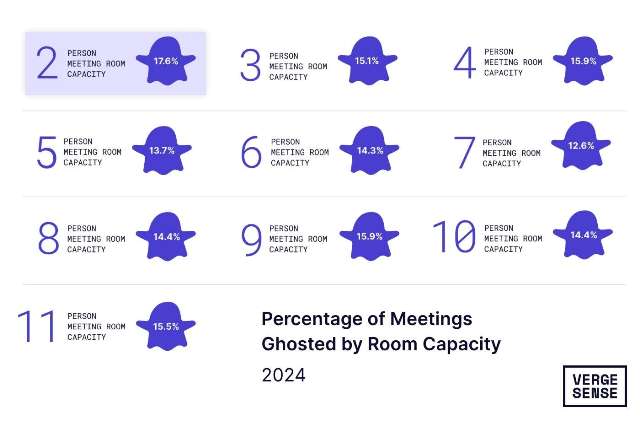
“In many offices, there’s a high supply of desks that aren’t fully utilized,” explains Cannell. “The bottlenecks we’re seeing aren’t at the desks, but rather in conference rooms and enclosed spaces for collaboration. That’s where demand exceeds supply.”
This disconnect creates a strategic opportunity for property owners and managers to reconsider space allocation. Companies are increasingly focused on understanding:
Passive usage (spaces held by laptops, backpacks, or jackets) versus active in-person usage
Shortage events (when 80% or more of a specific space type is in use simultaneously)
Optimizing spaces for team gatherings that previously might have occurred off-site
Decoding Utilization Metrics
For those new to workplace analytics, the raw utilization numbers might initially seem surprisingly low—typically 5-15% depending on the day. Cannell provides context for interpreting these figures:
“When we look at it on the aggregate basis, we are basing this off of the average measurement divided by total seats in the space. So that’ll count desk seats and every seat in a conference room, and the seats in different environments within the space.”
This standardized approach allows for consistent measurement across diverse environments, though individual companies often develop customized metrics for their specific needs. The data also reveals significant regional variations.
“One customer will see very different trends, for example, in their London location versus their Tokyo location versus their Seattle location,” Cannell points out.
The “Commute-Worthy” Office Experience
With hybrid work firmly established, companies are focusing on creating environments that justify the commute. VergeSense’s data helps identify which spaces deliver the most value beyond simple utilization rates.
“Maybe a certain type of event space is not used as often as our conference rooms, but it’s critical to the employee experience,” Cannell explains. “That becomes that commute-worthy piece.”
This recognition drives different evaluation strategies for various space types:
Event spaces: measured by frequency of peak events rather than daily usage
Collaborative areas: evaluated on efficiency and quality of interactions
Desks: analyzed for active time versus passive holding
Strategic Applications for CRE Professionals
For commercial real estate professionals, this granular data unlocks new strategic possibilities. The key, according to Cannell, is aligning measurement with objectives:
“The most power really comes from starting with the why—why are we doing things a certain way? What is our policy? What are we trying to accomplish? And that’s when we see our data become the most powerful decision supporter.”
Beyond informing portfolio decisions, these insights can guide:
Space type reallocation based on actual demand patterns
Operational cost optimization for cleaning, maintenance, and utilities
Environmental sustainability initiatives
“How can spaces be more sustainable if we understand how they’re being used?” Cannell asks, highlighting an increasingly important consideration for the industry.
Looking Forward: Confidence Returns to Workplace Strategy
After years of hesitation and uncertainty, VergeSense’s comprehensive data collection suggests 2025 will bring more decisive action in workplace strategy. The pandemic-induced paralysis that has gripped many organizations appears to be lifting as utilization patterns stabilize and clearer trends emerge.
“There’s been so much indecision, unknown and analysis paralysis in the last four or so years,” Cannell reflects. “This year, I am excited to see more of that confidence come into the decisions.”
This renewed confidence is manifesting in several ways. Property managers are reconfiguring spaces based on actual utilization data rather than assumptions. Corporate real estate teams are making more definitive long-term leasing decisions. And workplace strategists are designing environments that specifically address the demonstrated needs of their workforce.
For CRE professionals, leveraging this detailed utilization data will be essential for portfolio optimization and strategic planning. The ability to make data-driven decisions about space allocation, building operations, and long-term investments provides a significant competitive advantage in an evolving market.
As Cannell and the VergeSense team continue to refine their analytics capabilities, the resulting insights promise to bring greater certainty to an industry that has weathered significant disruption. By transforming raw utilization data into actionable intelligence, they’re helping to shape the next generation of workplace environments that better serve both organizations and the people who work within them.
This article was sourced from a live expert interview.
Every month we conduct hundreds of interviews with active market practitioners - thousands to date.
Every time a home goes on the market in the United States, the listing data – price, photos, square footage, descriptions – enters a multiple listing service. From there, that data gets copied. According to Tim Dain, President & CEO of NorthstarMLS, the regional MLS serving Minnesota, some MLS databases get replicated hundreds or even ...
The skilled-trade shortage in U.S. construction has persisted for years, but the industry’s response is taking a specific new form: developers are moving production into factories, and those factories are increasingly being built on American soil. For buyers in markets where labor constraints have slowed new housing and driven up prices, domestic factory production could ...
The company has already published over 5,000 articles in collaboration with over 1,800 market experts across all 50 states, powered by a tech-forward approach to research and reporting. MIAMI, FL – July 28, 2026: KeyCrew Media, the expert-sourced real estate news network, today unveiled KeyCrew Local, a network of local real estate news sites and ...
A 57-year publishing legacy joins forces with a modern editorial studio to deepen coverage and reach a new generation. SANTA FE, N.M. – July 23, 2026: Leading Estates of the World, the original luxury estates and lifestyle publication, today announced a partnership with KeyCrew Media to strengthen and elevate its coverage of the world’s finest ...
If you have ever watched an empty lot sit untouched for months, permit sign flapping in the wind, no workers in sight, and wondered what is taking so long, the answer may have less to do with lumber prices or labor shortages than you think. A growing number of development professionals argue that a quieter ...
Interest rates get most of the blame when commercial real estate deals stall. But in Houston’s industrial market in 2026, a different problem is collapsing deals that survive months of due diligence: federal policy that changes direction without warning. According to Shahin Naghavi, Managing Partner and Principal Broker at Riverside Equity Group, a boutique firm ...