“What if I could show you five or six actions that statistically reduce your likelihood of lease churn by 10 percentage points?” asks Ray Hespen, CEO and Co-Founder of Property Meld.
This isn’t just a hypothetical question. With data from over 750,000 rental units and approximately $1 billion in annual repairs, Hespen’s company has uncovered powerful correlations between maintenance practices and resident retention—potentially saving property owners thousands of dollars per unit annually.
From Mining Engineer to Maintenance Innovator
Hespen’s journey to revolutionizing property management began far from real estate. A mining engineer by training, he graduated during the 2008-2009 economic crisis and quickly learned to do more with less.
“As a plant manager in Sparrows Point, Maryland, I had to cut costs by 40% while maintaining production with the same team size,” Hespen explains. “That experience in systematic problem-solving and automation became the foundation for Property Meld.”
The company’s origin story began with a simple phone call from his co-founder, David Kingman, who asked about Hespen’s experiences with rental maintenance when he was renting.
“Requesting maintenance was painful enough that usually, if a repair didn’t cost that much, I would just do it myself, because it wasn’t worth the headache of going through management,” Hespen recalls. Kingman shared his frustration with the endless phone tag and communication breakdowns that characterized maintenance requests, seeing there could be a market opportunity.
That conversation – and a great deal of strategic effort – birthed what would become Property Meld. And today, the company serves approximately 2 million residents as the nation’s largest maintenance software platform for property management.
The Data Revolution in Property Management
What sets Property Meld apart isn’t just streamlining maintenance workflows—it’s the company’s ability to capture and analyze maintenance data at scale, transforming reactive property management into a predictive science.
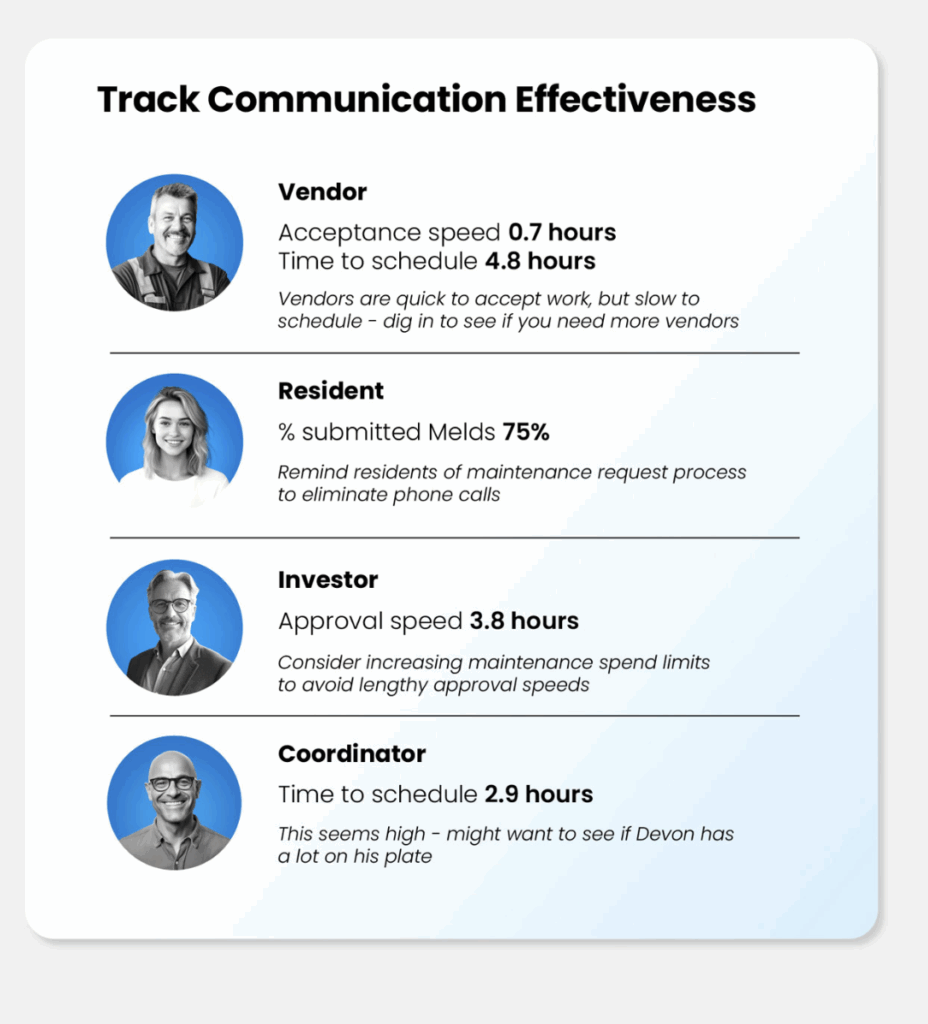
“If I told an investor that the number of service requests in the first year can change the renewal rate by 12%, that’s significant,” Hespen says. “Everybody thinks a 70% renewal rate is common. I’m talking about the difference between that and 82% just by managing maintenance effectively.”
Property Meld’s data analysis has revealed several key insights:
The type of repairs that happen in the first year can impact renewal rates by 11 percentage points
The volume of communication during service issues can affect renewal likelihood by 8 percentage points
Managing speed of repair appropriately can adjust lease churn rates by 10 percentage points
These findings are game-changing for an industry where a single turnover can cost $5,000 or more in lost rent, turnover costs, and leasing fees. “One turnover can wipe out NOI for an investor,” Hespen notes. “Statistically, you can alter that anywhere from $1,700 to $2,400 a year by just improving that renewal rate.”
From Firefighting to Optimization
Hespen sees property management evolving through distinct phases:
Firefighting: The chaos phase, where managers react to emergencies and rely on “exceptional people that have a ridiculous pain tolerance and can get yelled at all day.”
Control: Developing systems to identify problems before they escalate into angry phone calls.
Forecasting: Predicting workloads, resource allocation, and vendor performance.
Optimization: Using AI and data to make optimal decisions about resource allocation, vendor selection, and preventive maintenance.
“When we entered the market, it was firefighting 100%,” Hespen says. “Now the industry on the whole is anywhere between the firefighting and forecasting stage.”
The optimization phase represents the future—and potentially a market-defining advantage for early adopters. “When you reach that phase of maturation, the free market determines which companies thrive, attract more clients, and deliver more NOI to investors, while those not iterating quickly enough may struggle.”
The Vision: A Home That Almost Fixes Itself
Property Meld’s long-term vision extends beyond improving maintenance coordination. “We had this vision of a home that almost fixes itself,” Hespen explains.
He describes a future where data and IoT sensors can predict component failures before they happen: “With sufficient data, the system can inform the property manager that an air conditioner is due for replacement or a component needs to be replaced.”
In this scenario, the air conditioner never fails because the system has already dispatched the right technician, ordered the necessary parts, and scheduled the repair—all using AI. “The smart lock opens the door when you arrive, and the only person involved is the technician performing the repair,” Hespen envisions.
Such a proactive approach would dramatically reduces costs. “Everyone knows that fixing an air conditioner in June is about twice as expensive as fixing it in April, and buying an air conditioner in June is twice as expensive as buying it in February,” Hespen points out. So if timing could be optimized, the savings could be immense.
Recent Innovations: AI Intake and Decision-Making
Property Meld recently acquired Mezo, a leader in AI intake and triage for maintenance requests. This technology, called “Max,” functions like “the most friendly technician that doesn’t get mad at you when you don’t have the right wrench,” Hespen jokes.
The system helps residents troubleshoot issues, gathers clean data for technicians, and can predict component failures with 99.94% accuracy.
Looking ahead, Property Meld is rolling out an “optimal decision on assignment” tool that will recommend the ideal vendor or technician based on factors like cost history and resident lease churn risk.
“Imagine being a maintenance coordinator and seeing that a request represents a lease churn risk. The system recommends a highly-rated vendor who’s available in one and a half days and has previously serviced that property… That might be the perfect decision.”
The Future of Property Management
As property management evolves from a reactive industry to a data-driven, predictive one, Hespen sees a transformation in the role of maintenance professionals.
“That blue collar job is becoming more white collar—using data, information, and predictability to anticipate issues, resembling more of an Excel file than bringing a firehose as the primary tool,” he says.
For property owners and managers facing rising costs and pressure on rental rates, this evolution is timely. “In the next four to five years, this will likely be one of the biggest transformations in property management in the past 20 to 30 years.”
The ultimate goal? Creating an experience so seamless that residents never become frustrated enough to leave. And, in a market where every percentage point of resident retention translates directly to the bottom line, that improvement could be worth many millions to property owners nationwide.
This article was sourced from a live expert interview.
Every month we conduct hundreds of interviews with active market practitioners - thousands to date.
Plainfield, Illinois, about 40 minutes southwest of Chicago, spent the last two decades building itself into a family-oriented suburb with good schools, highway access, and prices well below neighboring Naperville. That growth phase worked. Families moved in, raised children, and put down roots. Now many of those original homeowners are entering retirement, and their homes ...
In a city with enough inventory to give buyers real leverage, the segment of the Houston housing market that should be busiest, homes priced between $300,000 and $600,000, is among the slowest to move. Properties below $300,000 are attracting first-time and value-oriented buyers, and listings above $500,000 continue to draw move-up purchasers with less rate ...
Most small mountain towns in the American West have a straightforward real estate story: pandemic-era demand inflated prices, and now those prices are correcting. Taos County, New Mexico, is not following that pattern. Per-square-foot prices there are still climbing, according to Karen Todd, a real estate professional with The Dragonfly Group at Berkshire Hathaway HomeServices ...
A declining median price usually signals a cooling market. In Northeast Dallas, the story is more complicated. The number of homes selling in 2026 has actually increased compared to 2024 and 2025, according to Cindy Dunnican of The Dunnican Team at Coldwell Banker Apex, who has worked the Northeast Dallas market since 1998. But the ...
Large builders in Delaware call their homes “affordable” when prices start at $300,000 to $350,000. For workers earning 40 to 80 percent of the area median income, roughly $35,000 to $60,000 a year in Delaware, those numbers don’t work, even with down payment assistance attached. The gap between what programs label affordable and what service-industry ...
Homeowners who bought during the 2022–2023 building boom in parts of southern Dallas-Fort Worth are discovering an uncomfortable reality: the new homes going up next door are priced at or below what they paid. For sellers who need to exit, the math often doesn’t work. Some are coming to the table with cash beyond their ...