Market Stadium is advancing how institutional investors evaluate multifamily opportunities by bringing granular, data-driven insights to market-level analysis through a synthesis of real estate expertise and data science. Founded by Ryan Kang and Dennis Lee, the company has established itself as a leader in advanced market analytics for the multifamily sector.
The company’s story begins at NYU’s Real Estate program, where Kang and Lee first crossed paths during their graduate studies. While Kang had been drawn to real estate for its tangible nature after exploring various finance sectors, Lee brought a passion for data research and urban planning technology. This combination of perspectives would prove crucial in developing Market Stadium’s unique approach to market analysis.
“Dennis was really into data research before. Back then, I didn’t have much knowledge of real estate data or technology, so he pretty much introduced the real estate tech world to me,” Kang explains. “He always talked about how real estate urban planning technology could change real estate investment.”
After graduation, both founders gained valuable industry experience – Kang in private equity focusing on multifamily acquisitions and development, while Lee joined one of the largest data-driven real estate private equity firms. Their vision for Market Stadium crystallized during a pivotal investment committee meeting where Kang needed to present a deal in Raleigh, North Carolina. Lee’s detailed market analysis, incorporating unconventional metrics like patents per employee to demonstrate innovation potential, helped secure committee approval and validated their approach.
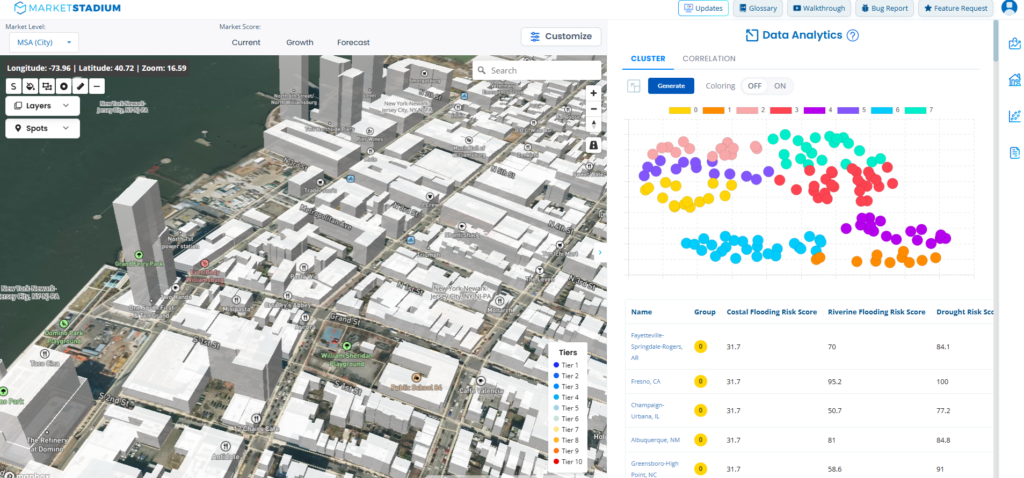
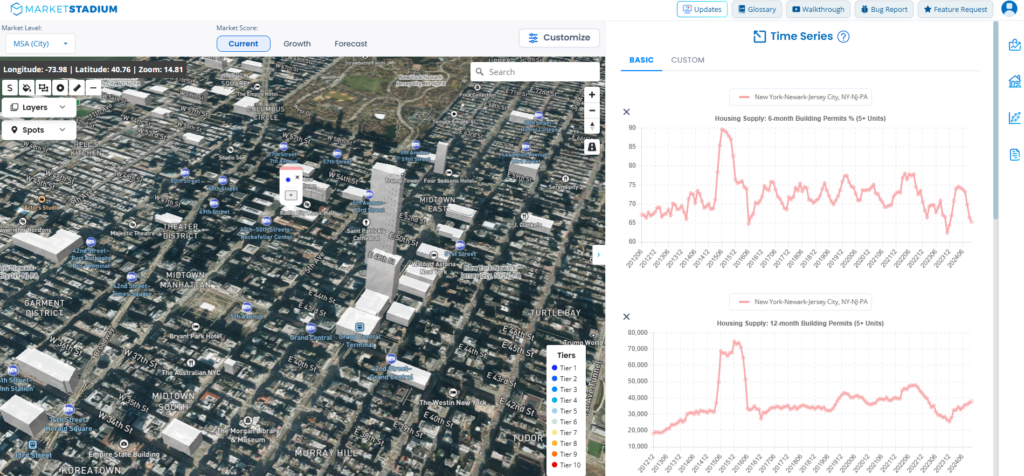
Today, Market Stadium distinguishes itself through its comprehensive market-level analysis. “We provide more than 500-plus type of data points that have high correlation with multifamily investment decision-making process, and then we let the users choose and create their own custom dataset,” Kang notes. “They’re creating their own custom index using their own investment thesis, reflecting their own perspective on the market.”
This approach addresses a significant gap in the market. While existing platforms excel at providing building-level metrics like sales comps and tax data, Market Stadium delves deeper, incorporating everything from venture capital funding flows to university R&D investments. The platform’s urban intelligence capabilities analyze commuting patterns and identify major employment and retail clusters, providing investors with a detailed view of market dynamics.
One of the platform’s key features emerged directly from client feedback: the ability to find markets with similar characteristics to areas where investors have already succeeded. Their cluster analysis tool can identify 10-20 comparable locations across different metros, allowing national investors to efficiently scale their geographic footprint while maintaining their investment thesis.
The company’s development process leverages the founders’ complementary strengths. Kang handles most client communications, gathering insights about user needs and pain points, while Lee leads product ideation and design. This collaboration, supported by their technical and data teams, enables rapid iteration and refinement of features based on real user feedback.
Looking ahead to 2025, Market Stadium is expanding beyond its current focus on acquisitions and development teams to serve asset management professionals. The company plans to introduce automated reporting capabilities that will help portfolio managers track market trends on a monthly basis, complementing their existing forward-looking analytics.
With a team that includes PhD-level urban planning and data science experts, Market Stadium continues to advance market analysis methodology. Their research team regularly publishes original insights, contributing to the industry’s understanding of market dynamics while demonstrating their analytical capabilities.
For an industry that has historically relied on conventional metrics and local knowledge, Market Stadium represents a sophisticated approach to data-driven decision making. By combining traditional real estate expertise with data science and urban planning intelligence, they’re enabling institutional investors to make more precise decisions in today’s complex market environment.
About Market Stadium: Market Stadium provides advanced market analytics for multifamily and single-family rental investors, with a specific focus on acquisitions and development teams. Their platform offers over 500 unique data points and sophisticated urban intelligence capabilities to help institutional investors make more informed investment decisions. Learn more at marketstadium.com.
This article was sourced from a live expert interview.
Every month we conduct hundreds of interviews with active market practitioners - thousands to date.
Plainfield, Illinois, about 40 minutes southwest of Chicago, spent the last two decades building itself into a family-oriented suburb with good schools, highway access, and prices well below neighboring Naperville. That growth phase worked. Families moved in, raised children, and put down roots. Now many of those original homeowners are entering retirement, and their homes ...
In a city with enough inventory to give buyers real leverage, the segment of the Houston housing market that should be busiest, homes priced between $300,000 and $600,000, is among the slowest to move. Properties below $300,000 are attracting first-time and value-oriented buyers, and listings above $500,000 continue to draw move-up purchasers with less rate ...
Most small mountain towns in the American West have a straightforward real estate story: pandemic-era demand inflated prices, and now those prices are correcting. Taos County, New Mexico, is not following that pattern. Per-square-foot prices there are still climbing, according to Karen Todd, a real estate professional with The Dragonfly Group at Berkshire Hathaway HomeServices ...
A declining median price usually signals a cooling market. In Northeast Dallas, the story is more complicated. The number of homes selling in 2026 has actually increased compared to 2024 and 2025, according to Cindy Dunnican of The Dunnican Team at Coldwell Banker Apex, who has worked the Northeast Dallas market since 1998. But the ...
Large builders in Delaware call their homes “affordable” when prices start at $300,000 to $350,000. For workers earning 40 to 80 percent of the area median income, roughly $35,000 to $60,000 a year in Delaware, those numbers don’t work, even with down payment assistance attached. The gap between what programs label affordable and what service-industry ...
Homeowners who bought during the 2022–2023 building boom in parts of southern Dallas-Fort Worth are discovering an uncomfortable reality: the new homes going up next door are priced at or below what they paid. For sellers who need to exit, the math often doesn’t work. Some are coming to the table with cash beyond their ...