In an industry where delays and cost overruns are the norm rather than the exception, Planera is revolutionizing construction scheduling by combining intuitive visual planning with AI-driven analytics to help project teams identify and solve problems before they cascade into costly delays.
“Construction projects are consistently late and over budget, and a significant factor is poor planning and scheduling,” says Nitin Bhandari, CEO of Planera, a construction technology startup improving how large-scale construction projects are planned and executed.
Why Construction Scheduling Is Different
Before diving into Planera’s solution, Bhandari emphasizes a fundamental truth about construction that many outside the industry don’t grasp.
“Many of us working in tech have almost forgotten that you need a good, solid plan before you start executing,” he says. “In tech, we’ve become very agile, ‘we’ll try to do these six things, but if we can only do three, we can still ship it.’ That works well in tech, media, and advertising.”
Construction doesn’t have that flexibility for two critical reasons: contractual obligations and physics.
“You are contractually obligated to deliver something. Nothing less is acceptable,” Bhandari explains. “And numerous laws of physics apply. You must do certain things in a certain way. You can’t just say, ‘I’ll build a roof, skip this part and ship it anyway.'”
This reality makes construction scheduling both essential and exceptionally challenging.
Breaking Down Silos Between Expertise and Tools
Traditional construction scheduling tools present a significant barrier: they’re powerful but prohibitively complex.
“Only a couple of people in a company of 200-300 employees may know how to use scheduling software, but those people aren’t close to the job being built,” Bhandari points out. “And people who are very close to the job don’t know how to use the software.”
This creates a critical disconnect between those who understand the scheduling tools and those who understand the actual construction process, which Planera aims to eliminate.
“What we built in Planera is something powerful enough to handle complicated workflows, yet easy enough to use that all project teams can collaborate and build a schedule together,” says Bhandari. “The best plans emerge when people with subject matter expertise can collaborate to build a plan, pressure test it, and perform scenario analysis.”
A Visual Approach to Complex Scheduling
Bhandari describes the traditional scheduling interface as overwhelming: “A typical scheduling software would be a list of activities on the left and bar charts on the right. A complex project might have 2,000, 5,000, 8,000 line items like that, with a rat’s nest of things connecting each other. It’s just mind-numbing.”
Recognizing that construction professionals are visual thinkers who excel at whiteboard planning, Planera took a different approach.
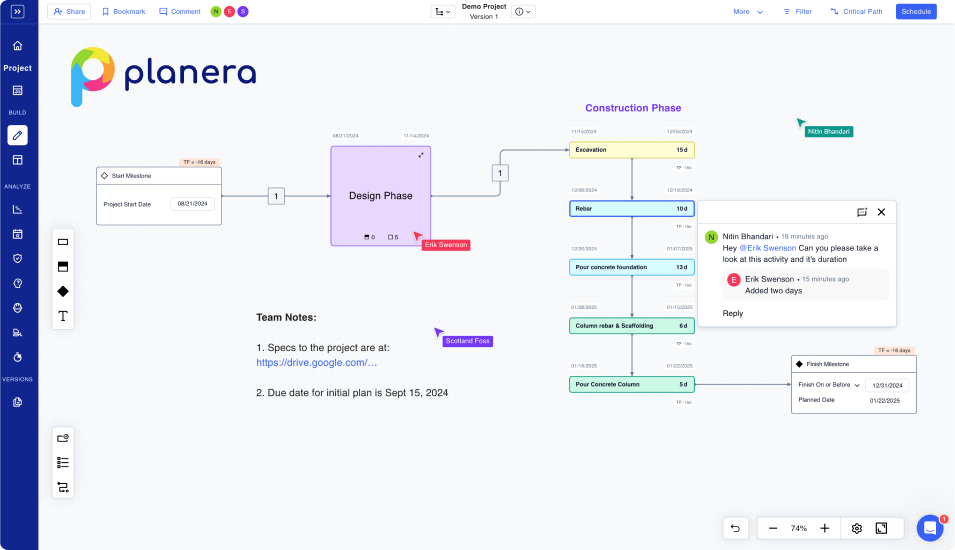
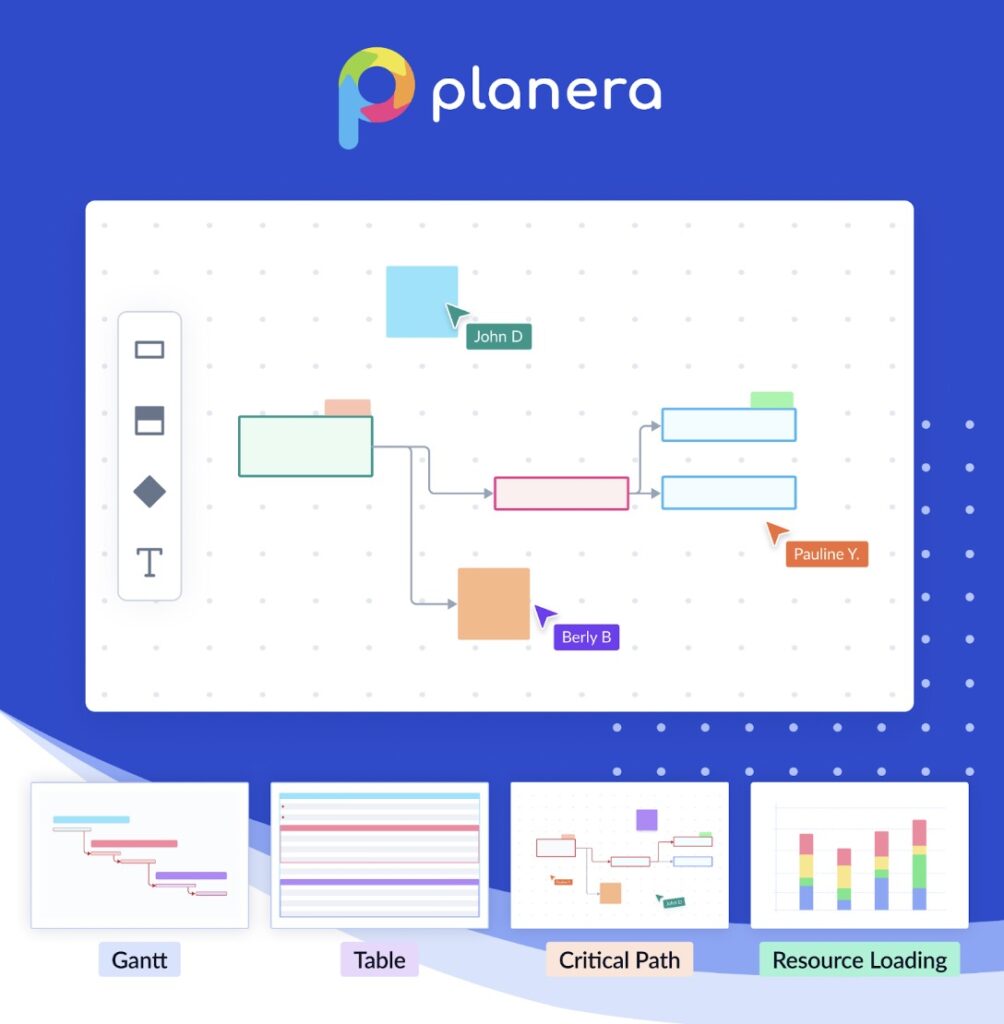
“What we built at Planera maintains the valuable Gantt chart but adds a digital collaborative whiteboard where everybody can draw a flow of activities. From that, our algorithms automatically create the Gantt chart and calculate resource and labor requirements.”
This visual approach makes complex scheduling accessible to the entire project team while still handling the scale required for major projects.
“It isn’t just for small, simple schedules. You can create 5,000-10,000 line item schedules in Planera,” Bhandari notes. “We have data centers running on Planera. We have airport expansions, highways, dam retrofits, high-rises, and commercial buildings.”
Managing the Inevitable: Turning Delays into Actionable Insights
Rather than focusing solely on preventing delays—which are often unavoidable—Planera helps teams minimize their impact by providing clear visibility into the ripple effects.
“The thing with delays is that sometimes they are just unavoidable,” Bhandari acknowledges. “The focus for a good schedule and plan is really not to overemphasize ‘How do I avoid the delay?’ but to figure out ‘How do I then minimize the impact of that delay?'”
In traditional scheduling, when a delay occurs, “a bunch of dominoes fall, but you just don’t know which ones fell. You have no idea what the implication of that was until you get close enough to that task. And then you’re scrambling.”
Planera’s approach is different: “When some cause and effect happens, how do we take that and convert it into actionable insights? If you can have that conversation with a trade partner three months in advance, no big deal. You can recover from that very easily. If you’re going to have that conversation two days before, they’re like, ‘Hey, my crew is already there. Somebody has to pay for it.'”
This ability to see downstream effects early—when teams still have options—is what Bhandari calls Planera’s “superpower.”
From Mobile Internet to Construction Tech
Bhandari’s path to construction technology wasn’t direct. An electrical engineer by training, he worked during the dot-com boom building internet infrastructure before launching his first startup in 2007.
“Imagine there was a world before iPhone, and that was the world my first startup actually started in,” Bhandari recalls. “There were still these Palm Pilots and Windows Mobile devices, and people were starting to use mobile internet. My first startup accelerated mobile internet, if you wanted to watch video or browse internet on Verizon, T-Mobile networks, my first startup was probably playing a part in that.”
After selling that company and launching another successful venture, Bhandari was introduced to the construction industry through his co-founder, who had been running a general contracting firm for about 35 years.
“He and his company and all his peers were consistently struggling with construction scheduling and planning,” Bhandari explains. “That’s the problem we’re trying to solve with this company. To help builders improve scheduling and planning and stay on top of all the problems that happen during construction.”
Backed by Industry Leaders
Planera’s innovative approach has attracted significant investment. The company recently announced a Series A funding round backed by a syndicate of both SaaS investors (Sierra Ventures and Sorenson) and construction tech VCs (Brick & Mortar and Prudence).
“We used our seed round to develop the concept and address the secular shifts happening in the industry,” Bhandari explains. “Construction scheduling has been running on-prem, meaning on data servers. It hasn’t been collaborative. People are still sharing files with each other, with changes being lost in the shuffle.”
Planera’s cloud-native, collaborative approach has proven successful with not just mid-sized general contractors but also “world’s top general contractors being Planera users.”
The Series A funding will allow the company to grow its go-to-market teams while continuing to invest in R&D efforts.
What’s Next for Planera
Planera is already managing 25 million days of cumulative schedules for its customers, but Bhandari has ambitious plans for the future.
“The next set of investments for us will be in giving users more capabilities,” he says. “All of these things that they have to worry about on a day-to-day basis, we’re going to make easier with machine learning, AI, and intelligence.”
The company is also expanding its platform capabilities. “We recently went into beta with our iPad app. For the first time, people can do collaborative pull planning and scheduling on their iPads. Sometimes in the field, they don’t have laptops. They have iPads only. They can walk the job site on that iPad, they can do actual progress tracking.”
The Broader Construction Tech Landscape
Looking at the construction technology space more broadly, Bhandari sees reality capture as another important trend.
“Reality capture is very interesting. It’s also a complicated thing. There’s no one solution that can solve all those problems, but I think reality capture is another one of those things that fundamentally changes the way construction is done: progress tracking, being able to see time-lapse of what’s been installed, quality control.”
For an industry that has historically been slow to adopt new technologies, solutions like Planera represent a significant shift toward more data-driven, collaborative approaches to construction management. By making sophisticated scheduling tools accessible to entire project teams and providing actionable insights from inevitable disruptions, Planera is addressing one of the construction industry’s most persistent challenges: keeping complex projects on time and on budget.
This article was sourced from a live expert interview.
Every month we conduct hundreds of interviews with active market practitioners - thousands to date.
Plainfield, Illinois, about 40 minutes southwest of Chicago, spent the last two decades building itself into a family-oriented suburb with good schools, highway access, and prices well below neighboring Naperville. That growth phase worked. Families moved in, raised children, and put down roots. Now many of those original homeowners are entering retirement, and their homes ...
In a city with enough inventory to give buyers real leverage, the segment of the Houston housing market that should be busiest, homes priced between $300,000 and $600,000, is among the slowest to move. Properties below $300,000 are attracting first-time and value-oriented buyers, and listings above $500,000 continue to draw move-up purchasers with less rate ...
Most small mountain towns in the American West have a straightforward real estate story: pandemic-era demand inflated prices, and now those prices are correcting. Taos County, New Mexico, is not following that pattern. Per-square-foot prices there are still climbing, according to Karen Todd, a real estate professional with The Dragonfly Group at Berkshire Hathaway HomeServices ...
A declining median price usually signals a cooling market. In Northeast Dallas, the story is more complicated. The number of homes selling in 2026 has actually increased compared to 2024 and 2025, according to Cindy Dunnican of The Dunnican Team at Coldwell Banker Apex, who has worked the Northeast Dallas market since 1998. But the ...
Large builders in Delaware call their homes “affordable” when prices start at $300,000 to $350,000. For workers earning 40 to 80 percent of the area median income, roughly $35,000 to $60,000 a year in Delaware, those numbers don’t work, even with down payment assistance attached. The gap between what programs label affordable and what service-industry ...
Homeowners who bought during the 2022–2023 building boom in parts of southern Dallas-Fort Worth are discovering an uncomfortable reality: the new homes going up next door are priced at or below what they paid. For sellers who need to exit, the math often doesn’t work. Some are coming to the table with cash beyond their ...