When buyers relocate to a metro area where they have no local ties, the usual priorities – square footage, lot size, finishes – often take a back seat to something harder to measure: a built-in social life. In the suburbs east and south of Tampa, communities with shared amenities like pools, splash pads, and lakefront access are consistently outselling comparable homes in neighborhoods that lack them. The gap is wide enough to suggest that buyers are paying for belonging, not just real estate.
Ryan Fernandez, a 14-year real estate veteran at Elevated Realty in Riverview, Florida, says the pattern is unmistakable in her day-to-day listing and showing activity. She estimates about 60 percent of her work is on the listing side, and the speed at which a home moves depends heavily on whether the surrounding community offers shared recreational spaces.
Transplants Need a Front Door to Community
Tampa Bay absorbed a massive wave of relocating buyers in the years following the pandemic. While the initial rush has cooled, the area continues to attract families from other parts of the country. Fernandez notes that the area still has “such an influx of people who are not necessarily from Florida. And that’s how they meet people.”
A family moving from the Northeast or Midwest to a sprawling Florida suburb does not have a neighborhood network waiting for them. A community pool, a lakefront park, or a lagoon amenity becomes the place where their kids make friends, and they meet other parents. Buyers are treating shared social infrastructure as a requirement, not a bonus.
Fernandez says her clients reflect this directly: “I get people who are specifically looking at those kinds of communities and nothing else.” They are not browsing broadly and narrowing down. They start with the amenity-rich community as a filter and then look for a home within it.
What Is Actually Selling Faster
Fernandez says, “The homes that are selling quicker are the ones that have more of the amenities” – community pools, family activity areas, and shared recreational spaces. In a market where most homes are sitting 60 to 90 days, that speed advantage matters.
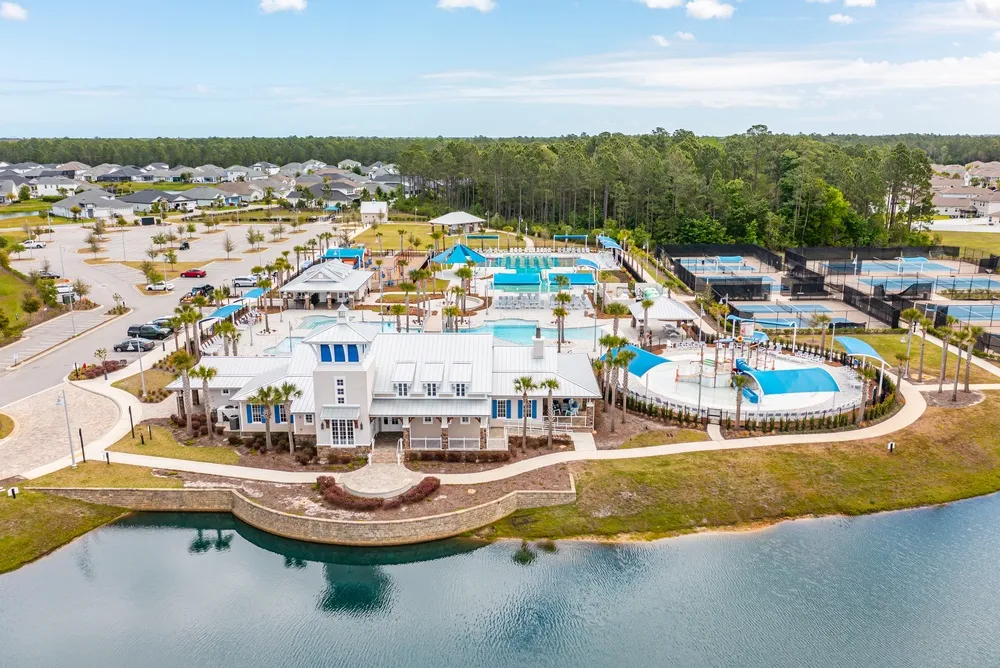
One of her current listings sits in a lakefront community with a boatable lake, pools, and a splash pad. She also points to lagoon-style communities in the area – developments built around oversized shared water features where residents can raft and kayak – as another format drawing strong buyer interest. These developments represent a bet by builders that shared recreation can drive home sales even in a cooling market.
Fernandez highlights Fish Hawk, a master-planned community, as a case where buyers relocate specifically for the neighborhood itself. “People will come to our area just to move to that particular neighborhood,” she says, because of its combination of schools and community orientation.
The Trade-Off Buyers Should Weigh
There is a cost to this preference, and it is not trivial. Many of Tampa Bay’s amenity-rich communities carry CDD fees – special taxing districts that fund the shared infrastructure buyers are drawn to. Fernandez estimates those fees add roughly $2,000 a year to a homeowner’s tax bill. And while the fees are theoretically set to expire after about 30 years, Fernandez says she is not aware of a community in her area where that has actually happened. She tells buyers to plan on paying them indefinitely.
That additional annual cost changes the math on affordability, especially for buyers already stretching toward the roughly $550,000 that Fernandez says most of her family-oriented buyers need to spend to get a three- or four-bedroom home with at least two bathrooms. Adding CDD fees on top of elevated insurance and property taxes pushes monthly payments higher – and some buyers draw a hard line. Fernandez says some clients tell her, “Absolutely no CDDs. We don’t want any additional costs that aren’t going into the property.”
The communities selling fastest are also the ones that carry the highest ongoing costs beyond the mortgage. Buyers who prioritize shared amenities gain a neighborhood that functions as a ready-made community, but they pay for it every year with fees that do not build equity. For a buyer relocating to Tampa Bay with no existing network, that trade-off may feel worthwhile. For a buyer already established locally, the calculus is different – and Fernandez says she sees both groups making opposite decisions on the same question.
About the Expert: Ryan Fernandez is a 14-year real estate veteran with The Fernandez Team at Elevated Realty in Riverview, Florida, covering Tampa Bay’s suburban corridors.
This article is intended for informational purposes only and does not constitute legal, financial, or investment advice. The views and opinions expressed herein reflect those of the individuals quoted and do not represent an endorsement of any company, product, or service mentioned. Readers should conduct their own due diligence and consult qualified professionals before making any investment decisions.